
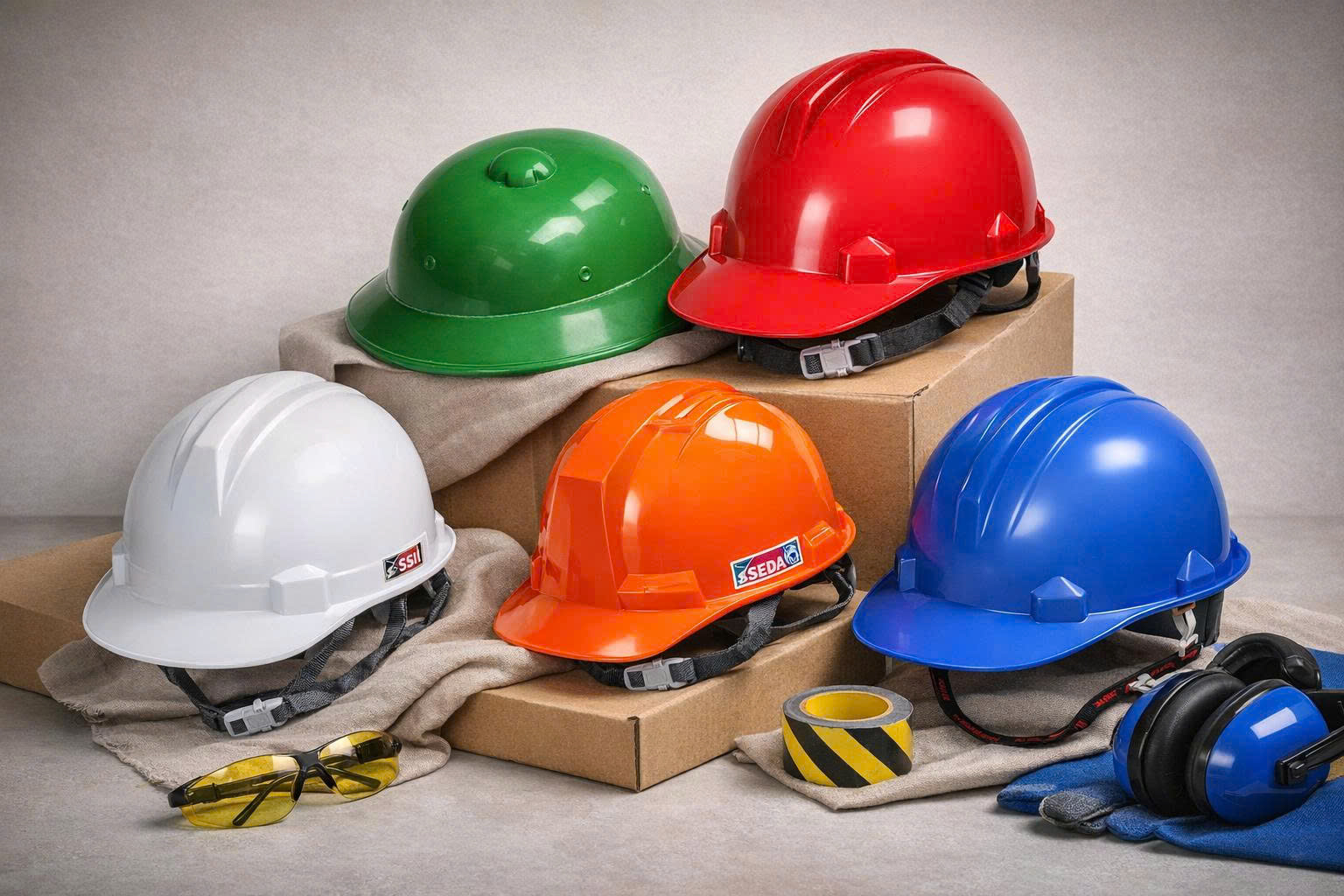
In today’s market, ABS and HDPE safety helmets are widely chosen by businesses thanks to their durability, lightweight design, and ability to meet worker protection needs across various work environments. So, how do these two types of helmets differ in terms of material, impact resistance, and price? Join Thiên Bằng in exploring the details in the article below!
ABS plastic safety helmets
ABS plastic safety helmets are protective work hats with a shell made from ABS (Acrylonitrile Butadiene Styrene)—a high-grade engineering thermoplastic known for its exceptional durability and heavy-duty impact resistance in harsh environments.
ABS plastic safety helmets feature the following outstanding technical characteristics:
- High impact strength and toughness: the polymer structure effectively absorbs impact energy when struck by falling heavy objects or during severe head collisions, minimizing the risk of cracking or breaking.
- Rigidity and wear resistance: the outer shell is extremely tough, scratch-resistant, and does not easily deform under typical mechanical stress.
- Effective electrical insulation: abs plastic is inherently non-conductive, ensuring high safety for workers operating near electrical sources.
- Heat and chemical resistance: it withstands elevated temperatures during outdoor work under intense sunlight and resists corrosion from common workplace chemicals.
- Aesthetic surface finish: the material produces a high-gloss, smooth finish that readily accepts vibrant colors and resists fading over time.

HDPE plastic safety helmets
Hdpe (high-density polyethylene) plastic safety helmets are protective hats with a shell made from high-density polyethylene—a common thermoplastic that offers great cost-effectiveness and a lightweight design.
Hdpe plastic safety helmets feature the following outstanding technical characteristics:
- Lightweight and comfortable: hdpe plastic has a lower density compared to many other plastics, helping reduce pressure on workers’ necks and shoulders when wearing the helmet continuously throughout long working shifts.
- Good toughness and flexibility: this material possesses high flexibility, allowing the helmet shell to bend easily and absorb light to moderate impact forces without becoming brittle or cracking.
- Superior chemical resistance: hdpe plastic offers exceptional resistance to a wide range of acids, alkalis, solvents, and corrosive chemicals, making it suitable for work environments in chemical plants.
- Good uv and weather resistance: the helmet demonstrates high durability against sunlight and harsh outdoor weather conditions.
- Cost-effective: thanks to common manufacturing processes and optimized raw material costs, these lines…

Technical specification comparison table: ABS and HDPE safety helmets
| Criteria | ABS plastic safety helmet | HDPE plastic safety helmet |
| Impact resistance | – Very high (Complies with EN 397 / ANSI Z89.1 standards):
– Typically withstands static compressive loads or impact forces equivalent to heavy objects falling from heights (absorption capacity up to 4,000N – 4,500N). – Rigid and sturdy shell, resistant to denting. |
– Fair (Complies with basic standards):
– Moderate impact resistance (typically fluctuates around 3,000N depending on design). – High elasticity, making it prone to slight dents upon heavy impacts, though it can partially recover its shape. |
| Weight | – Approx. 400g – 450g.
– Slightly heavier due to a solid, dense plastic structure. |
– Approx. 330g – 380g.
– Lighter, helping reduce neck fatigue during all-day wear. |
| Dielectric strength (Electrical insulation) | – High voltage compliance (Class E per ANSI or advanced options): Withstands test voltages up to 20,000 Volts. | – Standard electrical voltage suitability (Class G or basic standards): Withstands leakage voltages of approximately 440V to 1,000V. |
| Chemical resistance | – Stable resistance against common chemicals and oils. | – Very good, offering superior resistance to acids, alkalis, and strong solvents. |
| Temperature resistance limit | – Stable working temperature: Up to approximately 80°C – 90°C.
– Maintains shape exceptionally well under harsh sunlight at construction sites. |
– Stable working temperature: Below approximately 60°C – 70°C.
– More susceptible to softening or deformation if exposed to high temperatures for prolonged periods. |
| Price range (reference) | – Approx. 80,000VND – 250,000VND+/piece
(Generally higher due to durable, sturdy materials; premium/engineer tier). |
– Approx. 35,000VND – 90,000VND/piece
(Mass-market tier, cost-optimized for bulk purchases for workers). |
| Service lifespan | – Approx. 3 – 5 years
(High mechanical durability, good UV aging resistance, less prone to embrittlement over time). |
– Approx. 1 – 2 years
(Susceptible to prolonged outdoor UV exposure, gradually losing elasticity and becoming brittle). |
When to choose ABS and HDPE safety helmets?
Both ABS and HDPE plastic materials possess their own outstanding advantages. Understanding the specific characteristics of each type helps you choose the right product to maximize its effectiveness:
Choose ABS plastic safety helmets when
- Requiring high durability, heavy impact resistance, working regularly outdoors in harsh sunlight, or in dangerous electrical environments (requiring electrical insulation up to 20,000V).
- Suitable for: Electricians, workers on high scaffolding, heavy machinery operators, miners, or positions with high impact risks.

Choose HDPE plastic helmets when
- Requiring lightness for all-day wear without neck fatigue, working in warehouses or workshops (limiting exposure to harsh sunlight), exposing to chemicals, and needing cost optimization when purchasing in bulk for a large workforce.
- Suitable for: Factory assembly line workers, warehouse staff, mechanical workers in enclosed workshops.
Using the right type for each environment not only ensures maximum safety for workers but also effectively saves costs!

Reputable brands providing ABS and HDPE safety helmets
- SSEDA (Korea): Specializes in high-end ABS plastic helmet lines, outstanding for supreme impact resistance, excellent electrical insulation, and modern design.
- 3M (USA) & COV (Korea): Comprehensive supply of both ABS and HDPE materials, flexibly meeting requirements from strict demands of engineers to general needs of workers.
- Bảo Bình, Thùy Dương & Nhật Quang (Vietnam): Strong domestic brands in the HDPE plastic line, scoring points thanks to practical durability, accessible prices, and always available in large quantities.
Conclusion
Hopefully, the detailed insights above from Thiên Bằng have helped clear up your concerns and given you a comprehensive view to distinguish between ABS and HDPE safety helmets. There is no absolutely best type, only the most suitable type for your working environment and budget. Investing in the right helmet type is not only complying with safety regulations but also practically protecting the health and peace of mind for workers on every step of their work journey!
If your enterprise is looking for a safety helmet supplier for workshops and construction sites, please contact Thiên Bằng for advice on suitable products and to receive detailed quotes.
📞 Hotline: 0981.056.066 – 0966.831.477