
Working at height is one of the most hazardous working environments, requiring strict compliance with safety standards. To protect workers’ lives and ensure work efficiency, providing appropriate working at height safety equipment is an essential prerequisite that must not be overlooked. In this article, Thiên Bằng will provide a detailed overview of the necessary safety equipment and essential safety rules for working at height.
List of working at height safety equipment
Mandatory personal protective equipment (PPE)
- Full-body safety harness: A device that fits around the shoulders, chest, hips, and thighs to distribute impact forces evenly in the event of a fall, preventing concentrated forces that may cause spinal injuries. It must comply with standards such as EN 361 or QCVN 23:2014/BLĐTBXH.
- Lifelines and anchorage systems: Include single or double lifelines, shock absorbers, hooks, connectors, and load-bearing anchor points. This system connects workers to a secure building structure to limit free-fall distance and absorb impact forces.
- Specialized safety helmets: Helmets made from ABS or HDPE plastic that can withstand impacts from falling objects. They must have an adjustable chin strap that fits securely and a fastening knob to prevent the helmet from falling off when working at height.
- Anti-slip safety shoes: Equipped with durable rubber soles with high friction (meeting the SRC standard) to provide good grip on slippery scaffolding, steel structures, or sloping metal roofs.
- Protective gloves: Help improve grip when handling materials and construction tools, while protecting hands from direct contact with sharp surfaces or high-friction materials.
- Reflective vests: Improve visibility in low-light environments or during outdoor construction, minimizing blind spots and reducing the risk of collisions with nearby vehicles and machinery.
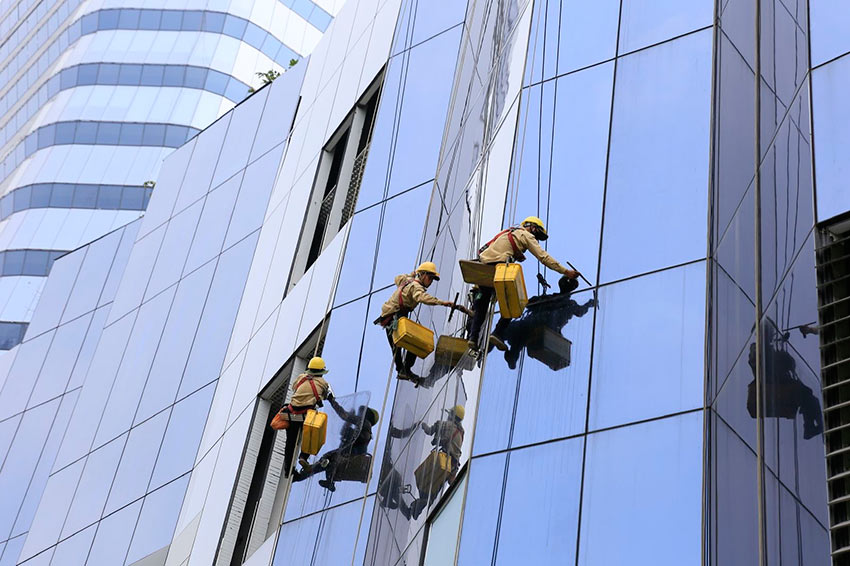
Supporting equipment for working at height
- Scaffolding and work ladders: Steel or aluminum alloy frame systems that meet load-bearing standards and are equipped with protective guardrails and anti-slip platforms.
- Mobile work platforms: Stable, load-bearing platform structures used for work areas without existing fixed support points.
- Rescue kits and controlled-descent devices: Backup equipment used for emergency evacuation when workers become trapped at height.

Safety rules for working at height
- Health checks before each shift: Only perform work at height when in good health, without signs of dizziness, vertigo, fear of heights, or after consuming alcohol, stimulants, or medications that cause drowsiness.
- Inspect working at height safety equipment before each use: Ensure that all equipment is intact and free from fraying, tears, cracks, breakage, or rust.
- Barricade and warn the area below: Set up warning signs, barriers, or safety nets beneath the work area to prevent unauthorized personnel from entering zones where falling objects pose a risk.
- Pay attention to weather conditions: Monitor the weather regularly; immediately suspend work and move to a safe location when heavy rain, thunderstorms, strong winds at force 5 or above, or excessively dark conditions with insufficient lighting occur.
Things to avoid when working at height
- Do not use damaged safety equipment: Never use equipment that has expired, is frayed, torn, cracked, broken, rusted, or has been subjected to a strong impact, such as equipment that has previously arrested a fall.
- Do not carry heavy loads while climbing: Do not hold heavy materials in your hands while using a ladder or scaffolding. Use specialized bags or lifting ropes to transport materials, and always maintain the three points of contact rule (two hands and one foot, or two feet and one hand) when climbing up or down.
- Do not engage in horseplay or become complacent while working: Do not walk freely on purlins, slippery metal roofs, or scaffolding without safety guardrails. Do not stand on makeshift supports, such as chairs, drums, or bricks, to reach higher areas.
- Do not throw tools or equipment down from height: All excess materials and tools must be placed in bags or lowered using ropes. Never throw them freely to the ground below.
Conclusion
Occupational safety is always a top priority on every construction site, especially when working at height. Investing in compliant safety equipment and exercising caution in every operation provides a strong line of defense in protecting workers’ lives. If you are looking for genuine, high-quality working at height safety equipment at competitive prices, contact Thiên Bằng today for dedicated consultation and support!
Contact information:
Hanoi office: 0981.056.066 – 0961.203.270
Ho Chi Minh City office: 0966.831.477 – 0986.720.134
You may also be interested in: Genuine safety harnesses at competitive prices with high load capacity