
Protective equipment for the manufacturing industry needs to meet stringent requirements regarding quality, durability, and safety standards to protect workers during the work process. Therefore, choosing a reputable PPE supplier is a crucial factor that businesses should not overlook. Let’s explore the selection criteria in the article below.
Product quality
When choosing a supplier of protective equipment for the manufacturing industry, businesses should consider:
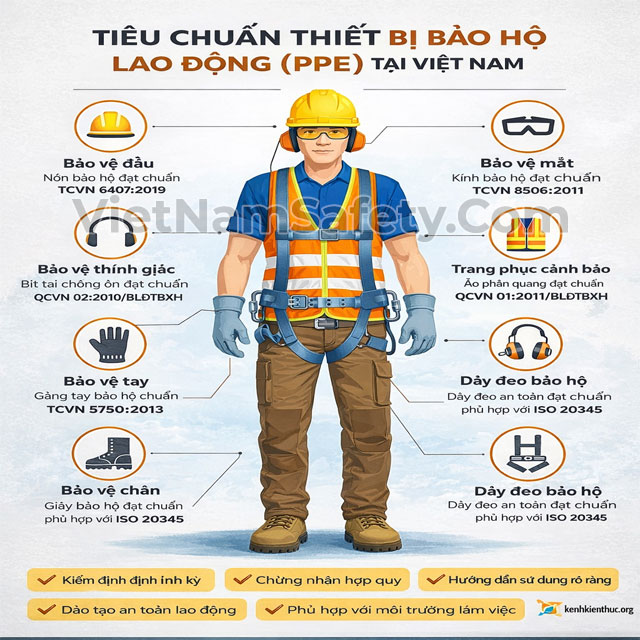
- Safety standards and certifications: Prioritize suppliers whose products meet standards such as TCVN, ISO 9001, EN, CE Marking, ANSI, and have complete certificates and documentation proving origin.
- Product materials and durability: Choose equipment made from suitable materials such as ABS plastic, HDPE, polycarbonate, aramid fiber, cotton-polyester blend fabric, etc., ensuring protection, durability, and comfort during use.
- Finishing quality: Check the manufacturing process, the sturdiness, and the stable operation of the product in a real working environment.
Supply capacity and customer support
Diverse safety product range
An ideal protective equipment for the manufacturing industry supplier should be able to provide a wide range of products to meet workers’ protection needs in different working environments.
- Head protection: Safety helmets, impact-resistant helmets.
- Eye and face protection: Safety glasses, welding masks.
- Respiratory protection: Protective masks, respirators.
- Hand protection: Safety gloves, cut-resistant gloves, electrical insulating gloves.
- Foot protection: Safety shoes, safety boots.
- Protective clothing: Reflective jackets, chemical-resistant clothing.
Customization requirements
- Manufacturing products according to business requirements.
- Printing/embroidering logos on protective clothing.
- Customizing colors, sizes, or designs.
Consulting and support services
A professional supplier not only provides products but also offers supporting services such as:
- Consulting on suitable protective equipment for each industry and working environment.
- Providing guidance on product usage, maintenance, and safety training for workers.
- Supporting inspection, maintenance, and replacement of genuine accessories.
- Offering clear warranty, return policies, and after-sales support.

Pricing and sales policies
Although price should not be the only deciding factor, pricing and sales policies remain important criteria when choosing a protective equipment for the manufacturing industry supplier, especially for businesses purchasing in large quantities.
Competitive pricing
- Comparing product prices with other suppliers in the market.
- Evaluating the balance between cost and quality to ensure investment value.
- Considering long-term usage costs, including maintenance, repair, and replacement expenses.
Discount and promotion policies
- Discounts based on order quantity or order value.
- Special offers for loyal customers, businesses, or long-term partners.
- Seasonal promotions, event-based offers, or new product launch programs.
Flexible payment terms
- Supporting multiple payment methods such as bank transfer, cash, card, or installment plans (if available).
- Flexible payment terms, including immediate payment or deferred payment within 30, 60, or 90 days according to agreement.
- Clear deposit policies for large-volume orders or customized products.

Delivery capability
Delivery capability is an important criterion when choosing a safety equipment supplier, especially for businesses that need to ensure production and construction schedules.
Delivery time
- Clear delivery commitments for each order.
- Ability to handle urgent or unexpected orders.
- Supporting order tracking during transportation.
Transportation capacity
- Having warehouse systems to ensure product availability.
- Cooperating with reliable shipping partners or owning a dedicated delivery team.
- Providing nationwide delivery, including remote areas and construction sites.

Supplier reputation and experience
Businesses should prioritize suppliers with many years of operation and strong customer trust.
Transparent business information
- Providing complete business information, including company name, tax code, headquarters address, and clear contact details.
- Maintaining updated official websites, fan pages, and sales channels.
- Providing invoices, documents, and legal certificates as required during transactions.
- Referring to feedback from customers in the same industry about product quality and services on websites, social media, or trusted review platforms.
Operating experience and capability
- Having many years of experience in the occupational safety equipment field.
- Possessing certificates, awards, or documents proving business capability.
- Having cooperated with many enterprises, factories, and large-scale projects.

Conclusion
High-quality protective equipment for the manufacturing industry not only helps protect workers but also represents a sustainable investment in business safety and reputation.
If you are looking for genuine, standard-compliant protective solutions, contact Thien Bang – a supplier with over 16 years of experience providing protective equipment for various industries such as manufacturing, construction, oil and gas, chemicals, metallurgy, and industrial production.
Contact us today to receive a special quotation:
📞 Hotline: 0981.056.066 – 0986.720.134
📩 Email: it.thienbang@gmail.com
See at more:
What Is Worker Protective Equipment? Common Types and Uses
Checklist Of Mechanical Protective Equipment
Protective Equipment For Businesses: Proper Investment, greater safety