
During work, ordinary glasses can easily become scratched by dust, metal particles, or frequent wiping, which can obstruct vision and reduce product lifespan. To address this issue, manufacturers have researched and developed scratch-resistant safety glasses featuring advanced lens coating technologies, providing greater peace of mind for workers. Join Thien Bang to learn more about this type of safety glasses in the article below.
Technologies used to manufacture scratch-resistant safety lenses
Hard coating (HC) technology
This is one of the most basic and widely used technologies. Manufacturers apply a special polymer layer or ultra-fine silica particles to both sides of the lens, which is typically made from polycarbonate or another lightweight synthetic material. Once cured, this coating forms a durable protective layer that helps prevent fine scratches caused by friction with dust, sand, or cleaning cloths.
Nano coating technology
Many major brands enhance conventional hard coatings by incorporating nanotechnology. Nano-sized material particles are tightly bonded to the lens surface, helping improve surface hardness while maintaining high optical clarity and minimizing image distortion.
Diamond-like carbon (DLC) coating technology
This technology is used for high-end safety glasses or specialized eyewear designed for demanding industrial environments. It applies a carbon coating with a structure similar to diamond to the lens surface, providing high hardness as well as strong resistance to chemicals, wear, and corrosion.
Choosing scratch-resistant safety glasses for different industries
- General mechanical work and light construction: Hard coating (HC) is suitable for these environments because it offers basic durability while keeping costs reasonable.
- Outdoor environments with fine dust and a need for clear vision: Nano coating can be considered for its ability to reduce dust adhesion and make the lens easier to clean.
- Heavy industry, chemical exposure, and welding slag (oil and gas, metallurgy): Diamond-like carbon (DLC) coating can provide high hardness, wear resistance, and chemical resistance, making it suitable for demanding working conditions.

How to properly clean scratch-resistant safety glasses
Step 1: Remove loose dust with clean water
- Gently rinse the entire pair of glasses, including both the lenses and frame, with cool, room-temperature water.
- The water will wash away most coarse dust particles, wood chips, metal particles, or sand from the surface without mechanical friction that could scratch the lenses.
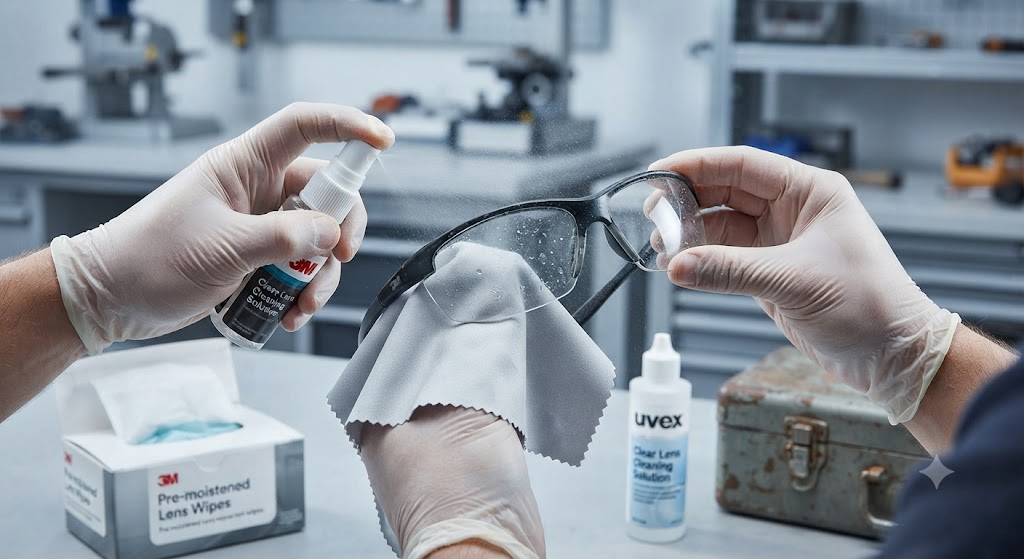
Step 2: Use a specialized cleaning solution
- Spray an appropriate amount of specialized lens cleaning solution designed for optical lenses or high-quality safety glasses onto both sides of the lenses.
- A specialized cleaning solution with a neutral pH helps remove grease, sweat, and fingerprints without damaging the surface coating.
Step 3: Gently clean by hand
- Use your thumb and index finger to gently rub the lens surface in circular motions to remove stubborn dirt.
- Make sure to clean the area where the lenses meet the frame, as sweat and fine dust often accumulate there.
Step 4: Rinse and dry
- Rinse the glasses again under clean running water to completely remove the cleaning solution and loosened dirt.
- Use a clean microfiber cloth to gently dry the glasses.
Important notes
- Never wipe the glasses while they are still covered with dust or dirt, as dust and sand particles can be rubbed directly against the surface and cause scratches on the protective coating.
- Avoid using soaps with strong cleaning agents or hot water, as they may damage the anti-scratch coatings (HC, Nano, DLC) or the anti-fog coating.
- Always use a specialized microfiber cloth. Never use tissues, paper towels, face towels, or clothing, as coarse fibers can gradually scratch the lenses.
- When not in use, store the glasses in a hard case or a soft protective pouch. Avoid placing them directly on a table or throwing them into a toolbox with other equipment.
- Keep safety glasses away from high-heat sources, such as direct exposure to welding areas, furnaces, or leaving them inside a motorbike compartment under strong sunlight. Excessive heat can deform plastic frames and cause optical coatings to crack or deteriorate.
Where to buy genuine scratch-resistant safety glasses
If you are looking for high-quality scratch-resistant safety glasses with clear product origins, Thien Bang Safety is a trusted destination with more than 16 years of experience in the safety equipment industry.
- Genuine international brands: An authorized distributor of products from leading global brands such as 3M and Honeywell, meeting strict technical safety standards.
- Transparent product origins: Products come with relevant documentation, including certificates of origin and conformity (CO/CQ), along with clear technical specifications, helping businesses feel confident during safety inspections.
- Diverse product range: Offers various options, from HC hard-coated lenses for mechanical work and light construction to anti-dust and anti-fog safety glasses for outdoor work and logistics, as well as specialized models for heavy industry and chemical environments.
- Flexible policies: Dedicated customer support for both individual purchases and large-volume orders, with competitive pricing policies for factories and businesses.
Contact Thien Bang for detailed advice on choosing the right safety glasses for your working environment and to receive a quotation.
Hanoi office: 0981.056.066 – 0961.203.270
Ho Chi Minh City office: 0966.831.477 – 0986.720.134
See at more: Chemical Safety Goggles: A Protective Shield for Your Eyes Against Chemicals