
In industrial production environments, workers are often exposed to dust, flying particles, chemicals, and other hazards that can cause eye injuries. Therefore, selecting safety goggles for the factory requires careful consideration, especially when purchasing in large quantities. Join Thien Bang as we explore the 7 key steps to help businesses choose the right products, protect workers, and optimize investment costs.
Step 1: Survey and classify the risk environment
This is the foundational step for determining the right type of safety goggles for the factory for each work area. No single type of goggles can provide optimal protection in every factory environment, as each production area presents different risks to workers’ eyes. The purchasing department should work with the HSE team to conduct an on-site assessment and create a risk map before selecting the product:
- Mechanical impact risks: In machining, cutting, grinding, and stamping areas, metal fragments or material particles may be projected at high speeds. These areas require goggles with good impact resistance that meet ANSI Z87.1+.
- Dust and small particle risks: Woodworking areas, cement mixing zones, and textile factories often generate various types of dust during production. Goggles with a close-fitting design, sealed edges, or soft cushioning can help prevent dust and small particles from reaching the eyes.
- Chemical splash risks: Laboratories, mixing areas, and plating lines may involve acids, solvents, or corrosive liquids. Workers should use specialized chemical-resistant goggles, particularly goggle-style designs that provide a tight seal around the eyes.
- Optical radiation risks: Welding, metalworking, or outdoor work can expose the eyes to UV (ultraviolet) and IR (infrared) radiation. Depending on the working environment, workers should use goggles with UV protection or welding goggles with an appropriate shade level.
Tip for distributors: Do not recommend a single type of goggles for the entire factory. Instead, classify products according to each work area and risk level. This approach demonstrates professionalism while helping customers invest according to their actual needs and avoid using high-end goggles unnecessarily in low-risk areas.
 |
 |
Step 2: Identify the required safety standards
After identifying the hazards in each work area, businesses need to select appropriate safety standards for the type of safety goggles for the factory they intend to use. These standards provide a basis for evaluating the product’s protective performance and quality. Two common standards include:
- ANSI Z87.1 (USA): Specifies requirements for optical quality and impact resistance. The “Z87+” marking indicates that the product provides high-impact resistance.
- EN 166 (Europe): Specifies requirements for eye protection, in which F indicates resistance to low-speed impact and B indicates resistance to medium-speed impact.
Note: When purchasing in large quantities, businesses should ask suppliers to provide a Certificate of Conformity to verify that the products actually meet the stated standards.
Step 3: Select lens materials and lens coating technologies
The lens is the part that directly protects the eyes, so its material and coating should be carefully considered. Polycarbonate (PC) is widely used because it is lightweight, highly transparent, and offers good impact resistance. In addition, businesses should pay attention to the following coating technologies:
- Anti-scratch/Hard coat: Helps reduce scratches and improve the durability and service life of the goggles.
- Anti-fog: Helps prevent lenses from fogging when working in humid environments or areas with changing temperatures.
- UV protection: Helps protect the eyes from ultraviolet radiation, particularly when working outdoors or in areas with UV radiation sources.
 |
 |
Step 4: Don’t overlook comfort and fit (Fit & Comfort)
Comfort and proper fit determine whether workers can wear safety goggles continuously for 8 hours of work. Even goggles with excellent protective performance may be removed if they cause discomfort, pain, or interfere with movement. When evaluating samples, businesses should pay attention to:
- Weight: Lightweight goggles should be prioritized to reduce heaviness and fatigue during prolonged use.
- Nose pads: Soft rubber materials with adjustable designs can help reduce pressure and discomfort on the nose bridge.
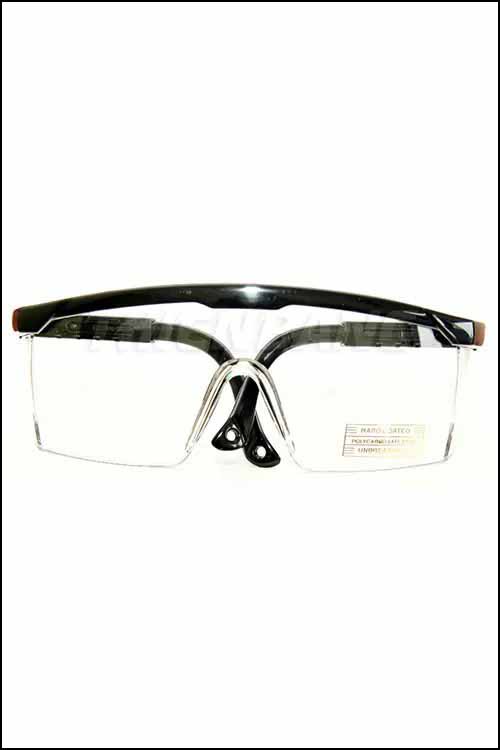
- Frame: Adjustable temple length or angle allows the goggles to fit a wider range of face shapes. The ends of the temples should also have soft padding for greater comfort.
- Design: A sporty, modern design not only improves wearing comfort but also helps workers feel more confident when using the goggles.
Step 5: Request samples and conduct real-world testing
Before placing an order for thousands of units, businesses should ask suppliers to provide or lend around 5–10 different samples for evaluation. Instead of testing them only at a desk, give the samples to workers in different production areas and let them wear the goggles for 1–2 days. Then, collect their feedback through a simple survey:
- Are the goggles comfortable to wear for long periods? Do they cause pain around the ears or nose bridge?
- Do the goggles fog up or become blurry during work?
- Is the vision clear? Is there any image distortion?
- Do the goggles fit securely around the face and provide a sense of safety?
Feedback from actual users provides a practical basis for accurately evaluating the products and making the final decision before placing a large order.
 |
 |
Step 6: Evaluate supplier capabilities – The “soft” factor behind success
As a professional buyer, a business is not simply choosing a product but also looking for a reliable long-term partner. Therefore, suppliers should be evaluated based on the following factors:
- Reputation and experience: Has the supplier previously served factories or industrial businesses, and do they have experience handling large-volume orders?
- Inventory and delivery capacity: Can the supplier provide the required quantity, maintain a stable supply, and deliver on schedule?
- Warranty and return policy: If defective products are discovered, does the supplier have a clear process for receiving and resolving complaints?
- Consulting and technical support: Does the supplier have a knowledgeable team that understands the products, standards, and working conditions to recommend suitable solutions?
Step 7: Cost considerations – Usage value matters more than purchase price
Do not simply choose the product with the lowest price. A pair of safety goggles costing VND 20,000 that scratches easily, fogs up, causes discomfort, and lasts only one week may actually cost more than a VND 60,000 pair with a quality coating, comfortable fit, and a service life of 2–3 months. Therefore, businesses should calculate the Total Cost of Ownership, including the purchase price, replacement costs, and potential risks.
Choosing safety goggles for the factory requires a balance between technical requirements, practical usability, and budget considerations. By following these 7 steps, purchasing teams and distributors can select suitable products, optimize costs, and, more importantly, ensure worker safety.

Need expert advice on safety goggles for the factory?
Effective eye protection goes beyond simply choosing a product that meets safety standards. Businesses also need a solution that suits their workers, working conditions, and equipment management practices across different departments. Thien Bang can support businesses with:
- Developing suitable protection plans based on production characteristics and the needs of different groups of workers.
- Offering a diverse range of products in terms of designs, materials, and features to meet different requirements.
- Advising on cost optimization by balancing durability, protection, and long-term usability.
- Supporting implementation from product consultation to additional supplies and replacements when needed.
Contact Thien Bang for advice on a suitable eye protection solution and take a more proactive approach to protecting workers’ eyes.
Hotline / Zalo:
- Northern Vietnam: 0981.056.066 – 0961.203.270
- Southern Vietnam: 0966.831.477 – 0986.720.134